Harriet Randall Lumis (1870-1953)

"I never drew or painted anything in my life until I was married." — Harriet Randall Lumis
Harriet Randall Lumis (1870–1953) was an American Impressionist landscape painter celebrated for her luminous depictions of the New England coast and countryside. A founding member of the Academic Artists Association, she remained devoted to representational painting throughout a career that spanned tonalism to high-keyed impressionism.
-
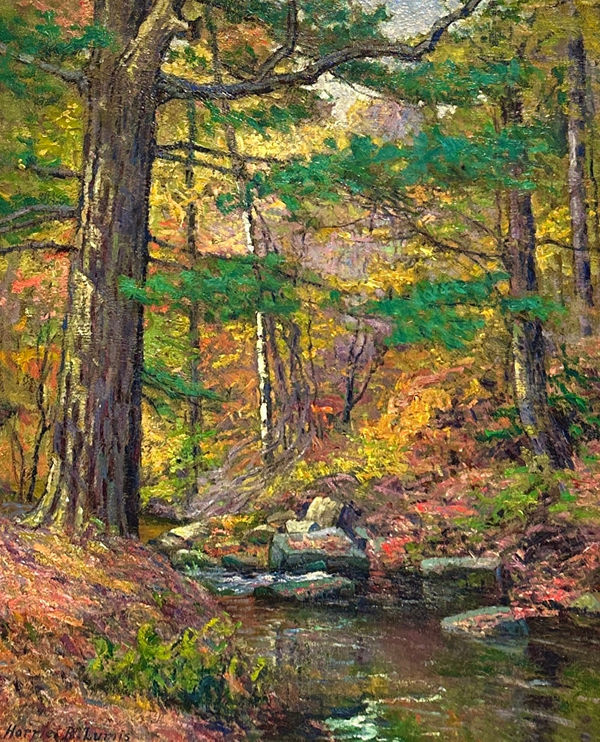
 "Forest Scene"
 -
Deerfield Valley

Harriet Randall Lumis was born on May 29, 1870, in the small farming village of Salem, Connecticut, near Norwich. Though she showed an early interest in sketching and was encouraged by her father, her formal art career didn't begin until after her 1892 marriage to Fred Williams Lumis, an architect who would go on to serve as Springfield, Massachusetts's building commissioner. The couple settled in Springfield, and it was there, enrolled in an evening drawing class alongside her husband, that Lumis's early interest in art turned into a lifelong commitment.
In Springfield she studied under several instructors, including Mary Hubbard, James Hall, Roswell Gleason Shurtleff, and Willis S. Adams — academic draftsmen and tonalist painters whose influence shaped her early, softly lit landscapes. Seeking further training, she traveled to Mianus in Cos Cob, Connecticut, in 1910 and 1911 to study with tonalist painter Leonard Ochtman at the New York Summer School. There she crossed paths with Cos Cob Art Colony figures John H. Twachtman and Childe Hassam, whose commitment to capturing specific locales with color and light steered her work toward French Impressionism. Beginning in 1920, she studied further under Hugh Breckenridge at his School of Art in East Gloucester, Massachusetts, refining her plein air technique.
Over the following decades, Lumis became known for vividly colored, atmospheric paintings of the New England landscape and coastline — particularly the harbors of Gloucester and Rockport, which became some of her most celebrated subjects. Her work was exhibited widely, including at the National Academy of Design, the Pennsylvania Academy of the Fine Arts, the Buffalo Society of Artists, the Connecticut Academy of the Fine Arts, and the Providence Society of Artists.
Lumis was deeply engaged in the artistic community of her era. She helped found the Springfield Art League, was elected a member of the National Association of Women Painters and Sculptors in 1921, and in 1949 co-founded the Academic Artists Association — an organization dedicated to defending realist and traditional painting against the rising tide of modernism and abstraction. From 1938 until her death in 1953, she taught landscape painting to new generations of students from her Springfield studio.
Harriet Randall Lumis died on April 6, 1953, in Springfield, Massachusetts. Though her reputation faded somewhat in the decades following her death, renewed scholarly interest in American Impressionism has since restored her standing, with a major retrospective touring museums in Missouri, Wisconsin, and Ohio in 1977–78. Today her paintings are held in numerous public and private collections, including the Springfield Museum of Fine Arts, the Butler Institute of American Art, and the Asheville Art Museum.