
William Lester Stevens (1888-1969)

“Celebrated for his expressive interpretations of the New England landscape, William Lester Stevens captured the region’s changing seasons, rugged terrain, and distinctive light with vigorous brushwork and a deeply personal sense of place.”
William Lester Stevens (1888–1969) was an American painter best known for his expressive landscapes of New England. Born in Rockport, Massachusetts, he studied at the School of the Museum of Fine Arts, Boston, and became a founding member of the Rockport Art Association in 1921.
Working in oil, watercolor, and acrylic, Stevens depicted the mountains, villages, harbors, farms, and changing seasons of New England with confident brushwork and a rich sensitivity to color and atmosphere. He exhibited widely throughout his career and became a full member of the National Academy of Design in 1943. Today, Stevens is recognized as an important twentieth-century interpreter of the New England landscape.
-
 Seascape with Boat
 -
The Old Apple Tree

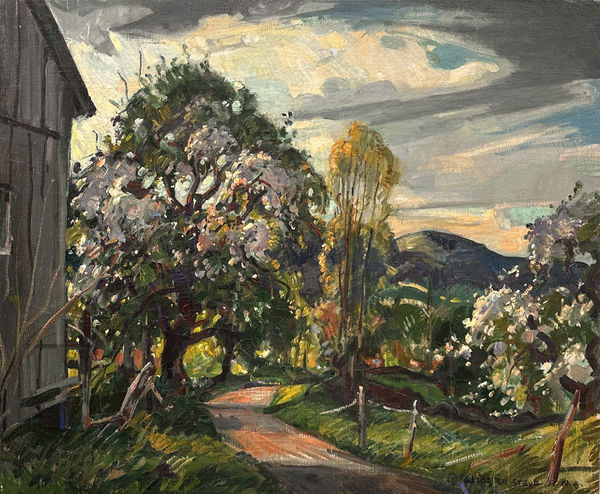
William Lester Stevens was an American painter celebrated for his expressive landscapes of New England. Born in Rockport, Massachusetts, Stevens developed an early connection to the coastal scenery and rural character that would remain central to his work throughout his career.
Stevens began his artistic training with Rockport marine painter Parker Perkins before attending the School of the Museum of Fine Arts, Boston, where he studied with leading figures of the Boston School, including Edmund Tarbell, Frank Benson, Philip Leslie Hale, and William McGregor Paxton. At just eighteen, he exhibited a work at the National Academy of Design, marking the beginning of a long and prolific professional career.
Following military service in Europe during World War I, Stevens returned to Massachusetts and resumed painting and exhibiting. In 1921, he helped establish the Rockport Art Association, contributing to Rockport's emergence as an important center for American artists. He subsequently taught at Boston University and Princeton University while continuing to exhibit widely.
Best known for his landscapes, Stevens painted the harbors, quarries, villages, farms, mountains, and changing seasons of New England. His work combines the observational traditions of the Boston School with a vigorous, increasingly personal approach to color and brushwork. Earlier paintings frequently feature substantial, impastoed surfaces, while later works often demonstrate a lighter and more fluid handling of paint. Although primarily associated with oil painting, Stevens also worked extensively in watercolor and acrylic.
Stevens received numerous awards during his lifetime and exhibited with institutions and organizations including the National Academy of Design, Pennsylvania Academy of the Fine Arts, Corcoran Gallery of Art, American Watercolor Society, and Guild of Boston Artists. He became a full member of the National Academy in 1943. His career also included public commissions, notably murals produced during the Federal Art Project for post offices in Rockport and Dedham, Massachusetts.
In the later part of his career, Stevens settled in Conway, Massachusetts, where the landscape of western New England provided continuing inspiration. Remarkably prolific and deeply committed to painting directly from his surroundings, he continued working until near the end of his life in 1969. Today, Stevens is recognized as an important twentieth-century interpreter of the New England landscape and a significant figure in the region's tradition of American Impressionist and realist painting.